Your wholesale business proves demand exists, not that you can serve it one order at a time
Adding a direct channel to your b2b ecommerce strategy is an operational readiness question before it is a marketing question. Your purchase orders already prove people want the product; what they don’t prove is that your operation can pick, pack, price, answer for, and take back a single unit.
Readiness runs on a spectrum, and most wholesale brands can find their own position on it in an afternoon. So the useful version of that strategy isn’t a b2b ecommerce platform shortlist; it’s an honest read on four operational capabilities and a sequence for closing whichever ones you’re short on.
Quick definition: b2b ecommerce is selling to other businesses through a digital channel, usually a b2b customer portal or a b2b self service portal, rather than through a rep, a phone call, or a faxed purchase order.
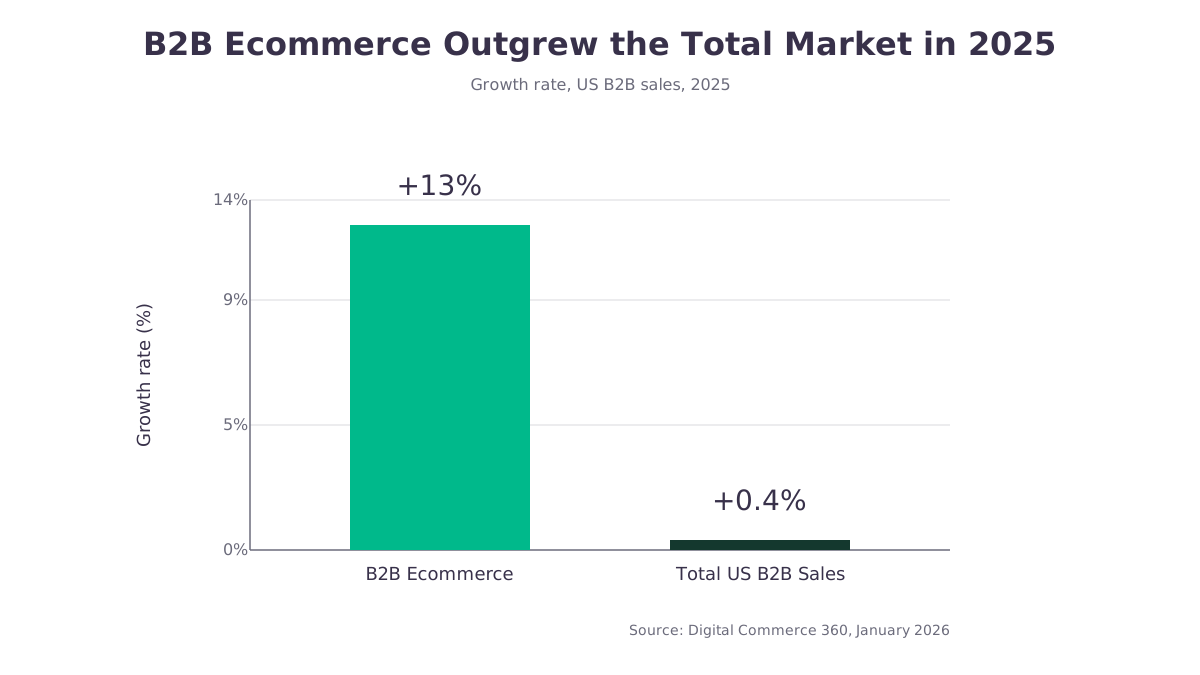
US B2B ecommerce grew 13% to $2.93 trillion in 2025 while total US B2B sales rose 0.4%, according to Digital Commerce 360’s analysis of Commerce Department data. Your buyers were already trained to order without talking to anyone, and the same expectation is now arriving from the other end of the chain.
A wholesale business running on repeat purchase orders is a genuine asset, and for plenty of brands it should stay the majority of revenue for years. The question isn’t whether wholesale is working; it’s whether a direct channel gives you something wholesale structurally can’t.
Control is one of those things. A client of mine, a high-ticket outdoor-wellness brand, had his distributor confirm a five-figure product was in stock on a Tuesday for a customer ready to buy, then pull it from availability two days later as the sale was closing.
Five years of working together, and the deal still evaporated with no warning. He lost it because someone else owned the inventory position, the timing, and the customer relationship at the moment all three mattered.
The four things that have to be true before selling direct pays
Four capabilities decide whether a direct channel earns money or quietly drains the wholesale business funding it.
- Unit-level fulfillment: moving one item to one address at a cost you can absorb, repeatedly, without pulling people off pallet work.
- SKU and pricing structure: an assortment a consumer can buy from, at a published price that doesn’t wreck your retail partners’ economics.
- Service load: capacity to answer hundreds of small questions a month instead of a handful of buyer emails.
- Returns: a policy you can honor at your margin once consumers return at consumer rates.
Almost no wholesale brand has all four on day one, and that’s normal rather than disqualifying. The distance between where you sit and where direct pays is your plan; treat it as sequencing information, not as a verdict on whether to go.
Fulfillment: a pallet operation and a parcel operation are different businesses
The strongest predictor of whether a first direct year works is whether anyone in your building has ever shipped one unit to one consumer on purpose.
A pallet operation and a parcel operation are different businesses that happen to share a building.
Where you sit on the fulfillment spectrum, from scheduled pallets to one-at-a-time shipping
One end of the range: everything leaves on a scheduled truck in case-pack quantities against a purchase order approved weeks ago. The other end: you already ship samples, warranty replacements, and employee orders one at a time.
Find your position by asking how many single-unit shipments left the building last month, and who packed them. If the answer is “a few, and it depends who’s around,” then what you have is a proof of concept rather than a process.
The cost per order you cannot see from your wholesale P&L
Your wholesale P&L hides the unit economics of a direct order because it never had to carry them: pick time, pack time, the box, the label, parcel freight, and the shipping subsidy consumers expect.
That last cost does the most damage. Extra costs at checkout, mostly shipping and fees, are the leading fixable reason US shoppers abandon a cart, cited by 39% of those who abandoned for any reason other than browsing, per Baymard Institute’s cart abandonment research. So you either build shipping into your direct price or you plan to absorb it, and both choices change what the new channel costs you before you’ve sold a thing.
What moves you up the range without a warehouse rebuild
Three moves cover most of it, in ascending order of commitment.
- A 3PL that already runs parcel volume: the fastest option and the cheapest to reverse, because you’re renting the capability while direct volume is still a question mark.
- A carved-out parcel bench: one table, one scale, one printer, one trained person, kept separate from pallet flow.
- One SKU as the pilot: pick a product that ships well and sell only that one direct for a season, so it generates real cost-per-order data before you commit the catalog.
The single-SKU pilot is the one I push hardest, because a season of real cost-per-order data is cheap compared with committing the whole catalog to a process nobody has run yet. If you can’t currently see what a single order costs you end to end, an outside read on your unit economics is usually the cheapest hour you’ll spend before launch.
Your SKU list was built for buyers who order by the case
A catalog that makes sense to a purchasing manager is often unreadable to a consumer buying one thing.
Case packs, minimums, and the assortment problem
Wholesale assortments are built around order efficiency: case packs, tiered minimums, part numbers that encode pack quantity, and variants that exist because one account asked for them. A consumer wants the single item, in the variant they care about, with a photograph and a name they recognize.
The product data in your ERP was built for that same buyer. b2b ecommerce erp integration solves order flow and inventory sync; it doesn’t turn part numbers and case dimensions into merchandising, so budget real time for consumer-facing product content.
The narrow-assortment start beats the full-catalog start almost every time
Launching with 12 to 30 consumer-ready SKUs tends to outperform launching the full line, because a small assortment concentrates demand, simplifies your pick process, and produces clean data on what direct buyers want.
Choosing which SKUs go first is a demand question rather than an inventory question, so start from category data and your own sell-through; our free ecommerce market research reports are a reasonable place to begin if you don’t have category numbers of your own.
Packaging that survives a parcel network and reads as retail on a doorstep
Wholesale packaging is engineered to survive a pallet and look right on a shelf under retail lighting. Parcel networks apply different abuse, and the box a consumer opens on their porch is the main physical brand experience you get.
Test the shipper before you launch rather than after the first breakage wave, and look hard at how your packaging reads to consumers who have never seen your product on a shelf.
Pricing direct is a channel-conflict decision before it is a margin decision
Your direct price is a message to your retail partners, and they’ll read it before your customers do.
How to talk to your retail partners before they hear it from a customer
Tell your largest accounts yourself, early, with specifics: which SKUs, at what price, on what timeline, and what you’re doing to protect their economics.
Partners rarely object to the existence of a direct channel; they object to hearing about it from a shopper or a sales rep. What you buy with an early conversation is the chance to shape the terms.
The pricing range that holds: what MAP, MSRP, and your partners’ economics leave you room to do
Minimum advertised price (MAP) is the lowest price a retail partner is permitted to advertise, and MSRP is the price you suggest they sell at. Your workable range typically runs from your MAP floor up toward MSRP, and the honest answer for most wholesale brands is to sell direct at or near MSRP. Undercutting your partners buys short-term direct volume and costs you shelf space, a poor trade while wholesale is still most of your revenue.
A b2b ecommerce pricing strategy that survives contact with your accounts usually differentiates on something other than price: exclusive variants, bundles retailers don’t carry, subscription refills, or configuration options that need your team.
What the extra margin is actually for
The gap between wholesale price and MSRP looks like profit on a spreadsheet and behaves like a budget in practice. It funds acquisition, payment processing, fulfillment, service, and returns, all of which your distributor used to carry.
The extra margin on a direct sale is the budget for acquiring and serving that customer.
The clearest historical example is one most people in consumer goods already know. When Dollar Shave Club launched into razors, Gillette held roughly 70% of global share and chose not to match the challenger’s price point; Unilever announced its acquisition of Dollar Shave Club on July 19, 2016, at a reported $1 billion on about $153 million in prior-year revenue, as TechCrunch reported at the time.
Dollar Shave Club never took over the category and Gillette remains the share leader today, so read it as history rather than as a forecast. The transferable lesson is about who is willing to cannibalize: if your category has an obvious direct buyer and you won’t serve them, the eventual direct seller in your category is someone else.
Service load is the cost most wholesale brands never model
Consumer service volume is not a bigger version of wholesale service volume; it’s a different function with different staffing math.
One buyer emailing your rep versus a thousand customers asking where their order is
A wholesale account generates a handful of touches per order cycle, usually from one trained person who knows your part numbers and lead times. Consumers generate questions per order, mostly about order status, shipping timing, sizing, or compatibility.
Your b2b order management process was built around scheduled, predictable communication. Consumer messages don’t arrive on that schedule.
The contact-rate math and what it means for headcount at your volume
Consumer contact rates typically run between 3% and 12% of orders, meaning 3 to 12 of every 100 direct orders generate a customer question. Run the math with a range rather than a point estimate: take your expected monthly direct orders, multiply by your contact rate, then divide by how many conversations one person can close in a day.
Simple, inexpensive, fast-shipping products sit at the low end of that range; configurable, expensive, or slow-shipping products sit at the high end. Any shipping delay pushes the rate up sharply, which is why fulfillment problems tend to surface first as a service problem.
What you can absorb with your current team, and the signal that you cannot
Most wholesale teams can absorb the first few hundred orders a month inside existing roles, and many should, because early direct conversations teach you things a dashboard won’t.
The signal that you’ve passed the line is usually response time drifting past a day, or your wholesale accounts noticing their rep got slower. At that point the honest options are part-time help, a shared inbox with real ownership, or a service partner.
Returns turn a good direct month into a bad one
Consumer return rates are structurally higher than wholesale return rates, and the difference lands entirely on your side of the ledger.
Wholesale returns are negotiated; consumer returns are expected
A wholesale return is an event: a damage claim, a discontinued line, a negotiated credit against a future order. A consumer return is a routine part of a transaction the customer assumed was reversible before they bought.
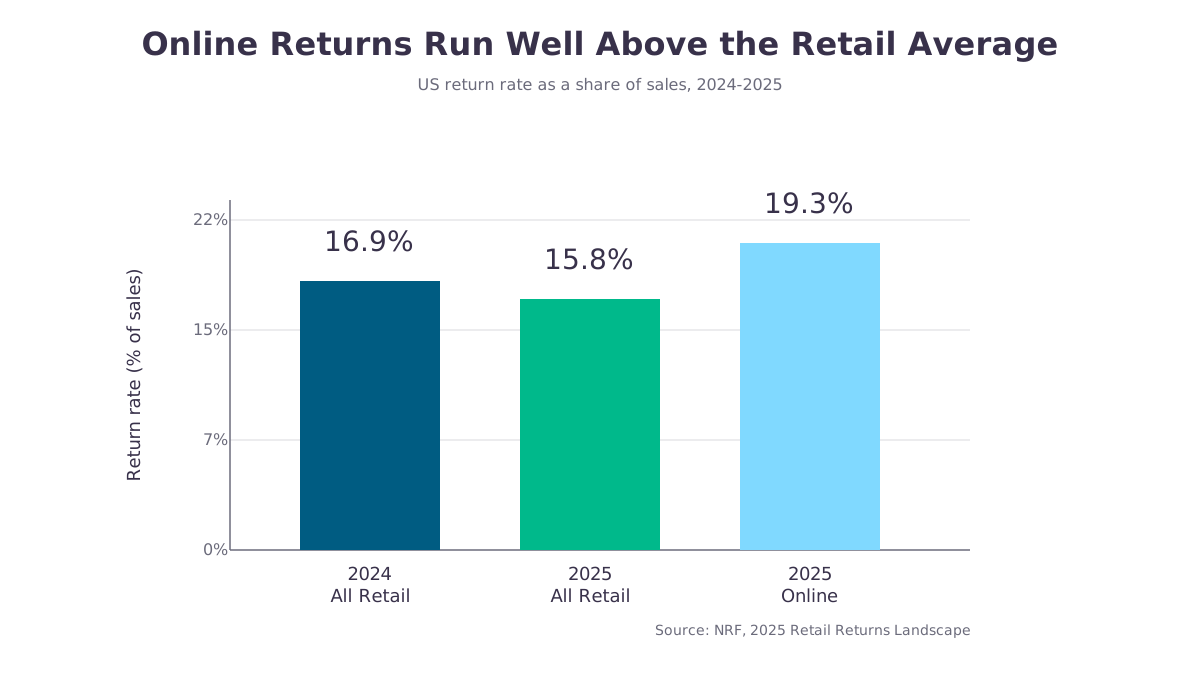
The National Retail Federation put the 2025 US return rate at 15.8% of sales, about $850 billion, with online returns running higher at an estimated 19.3%, in its 2025 Retail Returns Landscape report. Model roughly one in five direct orders coming back and you’ll be closer to reality than any wholesale-derived assumption gets you.
What a return costs you end to end, and why the restocking question decides your policy
Add up the outbound shipping you already paid, the return label, inspection labor, repackaging, and the write-down if the unit can’t go back to A-stock. That last variable decides most policies, because product built for case-pack distribution often can’t be resold once individual packaging has been opened.
If a returned unit resells at full price, a generous policy is affordable and probably worth it. If it becomes B-stock, your policy has to earn its cost through a restocking fee, a longer window framed around exchanges first, or a narrower return-eligible assortment.
A returns policy you can honor at your margin, written before launch instead of after the first wave
Write the policy before you take the first order, against the return cost you calculated rather than against what a competitor’s site says. Free returns are a real conversion lever, with 82% of consumers telling the NRF that free returns factor into their online purchase decisions, so treat any restriction as a trade you’ve priced deliberately.
The failure mode to avoid is a policy copied to look competitive, then quietly tightened three months in. Tightening a stated policy costs more trust than starting narrower and loosening later once your numbers support it.
If you’re weighing that trade and can’t yet tell what your true return cost will be, sitting down with your actual return numbers beats guessing from category averages.
How to tell which of the four you already have
Each capability has a signal you can check in your own data this week. This isn’t a scorecard with a passing grade; it’s a way to locate yourself and see what to sequence first.
| Capability | Signal you already have it | Signal you don’t | Cheapest way to close the gap |
|---|---|---|---|
| Unit-level fulfillment | Single-unit shipments go out weekly at a known cost per order | Nobody in your building can tell you what shipping one unit costs | A 3PL with parcel volume, or one SKU as a pilot |
| SKU and pricing structure | You could name 15 consumer-ready SKUs and their MSRP today | Your catalog is organized by case pack and part number | Narrow the assortment, then write consumer product content |
| Service load | Someone owns inbound questions with a stated response time | Buyer emails route to whoever is free | A shared inbox with one named owner before launch |
| Returns | You know what a returned unit resells for | Returns are handled case by case as credits | Cost one return end to end, then write the policy |
Where the answers live: fulfillment cost sits with whoever books freight, the assortment answer sits in sell-through by SKU, the service answer sits in the shared inbox, and the returns answer sits in whatever you did with the last damaged pallet.
Pick numbers worth tracking from week one and keep the list short, because early direct volume is too small to support a full dashboard and too important to run on instinct.
What the first ninety days look like from each starting position
The sequence changes with which capabilities you already have, and the timeline moves with your SKU count, how your partner conversations go, and how clean your product data is.
Strong fulfillment, weak service. Launch narrow and early and use the first phase to build the service function while volume is still forgiving. Expect eight to twelve weeks of assortment work, product content, and getting one person accountable for inbound questions.
Strong service, weak fulfillment. Your team can talk to customers, the harder capability to buy, so the near-term work is a fulfillment partner and clean cost-per-order data. A 3PL selection and onboarding commonly runs six to ten weeks from first conversation to first live order, longer if your product needs special handling.
Weak on both. Don’t launch a storefront in the first ninety days. Use that window for partner conversations, a single-SKU pilot through a 3PL, and the returns math, then reassess with real numbers instead of estimates.
Whichever position you’re in, treat the direct channel into your plan as a budgeting decision with its own costs and its own owner, rather than as a marketing initiative.
The case for staying wholesale-only, made honestly
For some brands the right answer this year is to keep selling through partners and get better at it.
Three conditions make direct the wrong call right now: wholesale demand already exceeds what you can produce, your product genuinely can’t ship economically as a single unit, or your two largest accounts carry enough revenue that a channel-conflict misstep would be existential. None of those is permanent.
US D2C ecommerce sales plateaued at roughly 19% of total US retail ecommerce and are forecast to stay flat through 2028, according to EMARKETER’s May 2025 forecast, so nobody in your position is running out of time.
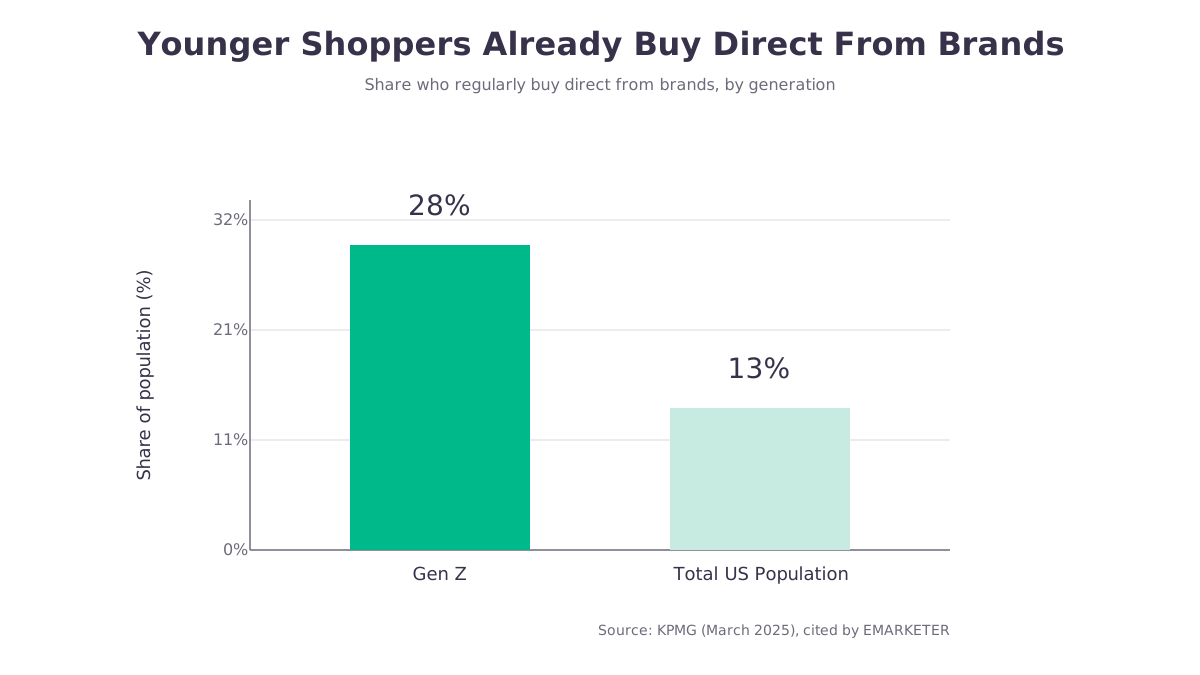
What patience shouldn’t become is a permanent position. The b2b ecommerce trends in your own channel already moved: your buyers order digitally now and the consumers in your category are moving the same way. KPMG data cited in that same analysis found 28% of Gen Z regularly buy direct from brands against 13% of the total population, which says a wholesale-only brand has a few years of runway and a generational trend running against it.
If you want an outside read before committing, that’s the kind of question an ecommerce consultant should be able to answer with your numbers in hand, and you should expect a range with conditions attached rather than a yes or no.
Getting good at wholesale is a real strategy, and running it well beats running a direct channel badly. The goal is to choose deliberately, with the four capabilities in front of you.